
Gaggawa ta Muhimmanci — Hangen Nesa na Ninka
Fahimtar cewa saurin da shugaba ke horas da wasu ya saita saurin dukan motsi a gaba. Wannan ba dabaru kawai ba ne — hangen nesa ne na ninka: tsare-tsare masu jinkiri da rikitarwa ana kwafi su kuma suna rage saurin kowace ƙarni ta gaba, yayin da sauri mai sauƙi da za a iya maimaitawa ke rayar da mafarkin ninka almajirai har tsawon ƙarnoni masu zuwa.
Shin kai giwa ne ko zomo?
Two pictures of the difference between addition and multiplication — and why the pace a leader sets today decides whether the next ten generations reproduce slowly, or explosively.
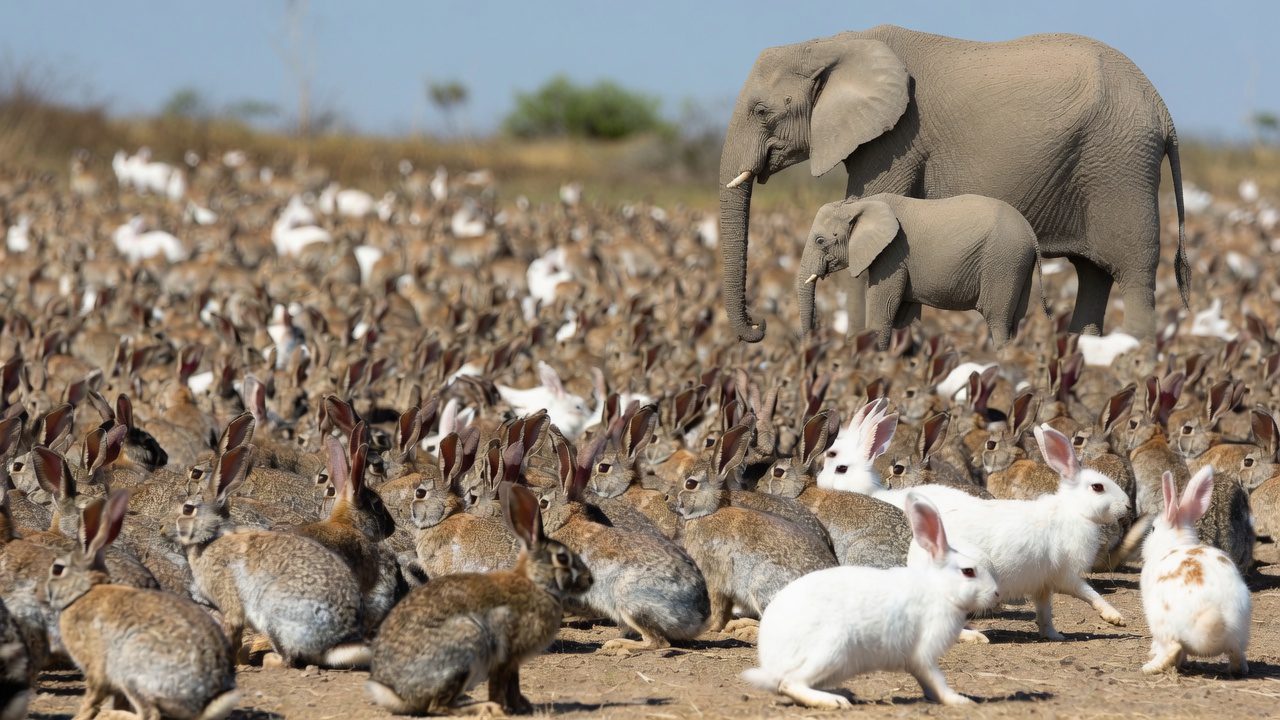
- Starts breeding at 10–11 years old
- Juna biyu na watanni 22
- 4–9 years between calves
- Ƙwaya suna da matuƙar wuya.
One leader, one disciple at a time — only ever as deep as one person can personally reach. Slow, complicated, dependent on the one. This is addition.
- Yana fara haihuwa a watanni shida.
- Cikin na kwanaki 30
- 4–12 babies per litter
Ɗaya mace da 'ya'yanta a ka'ida za su iya samar 50,653 a cikin shekaru uku, 69 miliyan a cikin shekaru biyar, da 64 biliyan a cikin shekaru bakwai.
Every disciple becomes a disciple-maker, who makes another, who makes another — simple and reproducible enough that anyone can pass it on. This is multiplication.
Dalilin da ya sa sauri yake da muhimmanci ga shekara ta 2033
2033 marks roughly 2,000 years since Jesus gave the Great Commission. That can feel impossibly far from “reaching the whole world” — until you remember that multiplication, not addition, is how small things become large fast.
Picture one disciple-maker who disciples two people a year who become disciple-makers themselves — and the pattern repeats:
Shekara ta biyar: 32 • Shekara ta 10: 1,024 • Shekara ta 20: over 1 million • Shekara ta 30: over 1 billion • Shekara ta 33: fiye da yawan mutanen duniya.
That is not a prediction of exactly how or when — only God knows the day or the hour. It is a picture of what is mathematically possible when multiplication replaces addition. It is why a process only a gifted leader can reproduce quietly caps a movement at one generation, while a pace ordinary people can copy keeps the chain unbroken for 10, 20, 30 generations — Gida zuwa gida. Ƙauye zuwa ƙauye. Ƙasa zuwa ƙasa. Nahiya zuwa nahiya. Har sai duniya baki ɗaya ta sani.