
Kasi Ni Muhimu — Maono ya Kuzidisha
Kuelewa kwamba kasi ambayo kiongozi huwafundisha wengine huamua kasi ya harakati nzima inayofuata. Hii si tu mbinu - bali ni maono ya kuzidisha: michakato mirefu na ngumu huigwa na kupunguza kasi ya kila kizazi kijacho, wakati kasi rahisi ya kuweza kuigwa huweka matumaini ya kuzidisha wanafunzi hai kwa vizazi vijavyo.
Je, wewe ni Tembo au Sungura?
Two pictures of the difference between addition and multiplication — and why the pace a leader sets today decides whether the next ten generations reproduce slowly, or explosively.
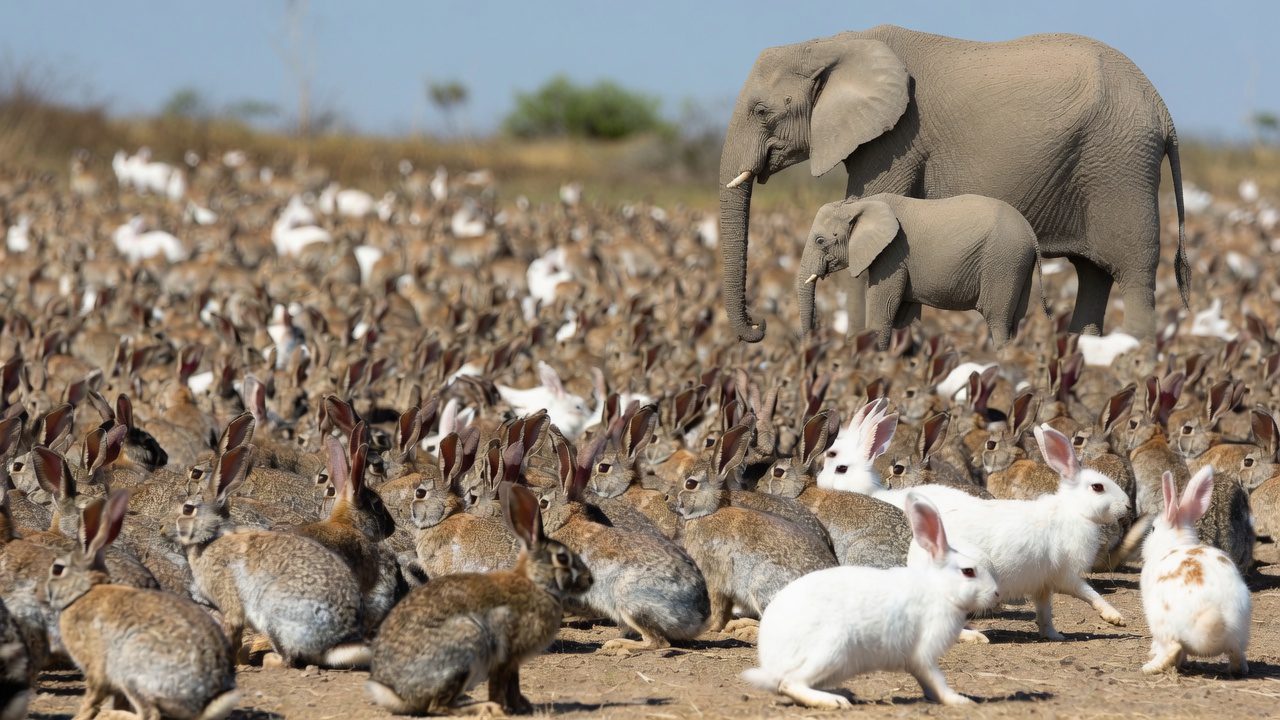
- Starts breeding at 10–11 years old
- Ujauzito wa miezi 22
- 4–9 years between calves
- Mapacha ni nadra sana
One leader, one disciple at a time — only ever as deep as one person can personally reach. Slow, complicated, dependent on the one. This is addition.
- Huanza kuzaa akiwa na umri wa miezi 6
- mfumo wa siku 30
- 4–12 babies per litter
Mwanamke mmoja na watoto wake wanaweza kutoa kwa nadharia 50,653 katika miaka 3, milioni 69 kwa miaka 5, na bilioni 64 katika miaka 7.
Every disciple becomes a disciple-maker, who makes another, who makes another — simple and reproducible enough that anyone can pass it on. This is multiplication.
Kwa nini kasi inamaanisha kwa 2033
2033 marks roughly 2,000 years since Jesus gave the Great Commission. That can feel impossibly far from “reaching the whole world” — until you remember that multiplication, not addition, is how small things become large fast.
Picture one disciple-maker who disciples two people a year who become disciple-makers themselves — and the pattern repeats:
Mwaka 5 32 • Mwaka wa 10 1,024 • Mwaka wa 20: over 1 million • Mwaka wa 30: over 1 billion • Mwaka wa 33 zaidi ya idadi ya watu duniani.
That is not a prediction of exactly how or when — only God knows the day or the hour. It is a picture of what is mathematically possible when multiplication replaces addition. It is why a process only a gifted leader can reproduce quietly caps a movement at one generation, while a pace ordinary people can copy keeps the chain unbroken for 10, 20, 30 generations — Nyumba kwa nyumba. Kijiji kwa kijiji. Nchi kwa nchi. Bara kwa bara. Hadi dunia nzima ijue.