
Pace Matters — Gis-gisu yokkute
Xam ne gaawaayu ni ab njiit di taalifee ay taalibeem mooy tek gaawaayu doxalinu mbooloo mépp mi ci topp. Lii du ay pexe rekk — gis-gis la ngir yokkute: doxalin yu yàgg te jafe dañuy toppandoo te di yeexal maas yépp yiy ñëw, fekk doxalin bu yomb te gaaw di dundal géntu yokk taalibe yi ci maas yiy ñëw.
Ndax Yaa Ngiy Doon Gémbu Walla Lapin?
Two pictures of the difference between addition and multiplication — and why the pace a leader sets today decides whether the next ten generations reproduce slowly, or explosively.
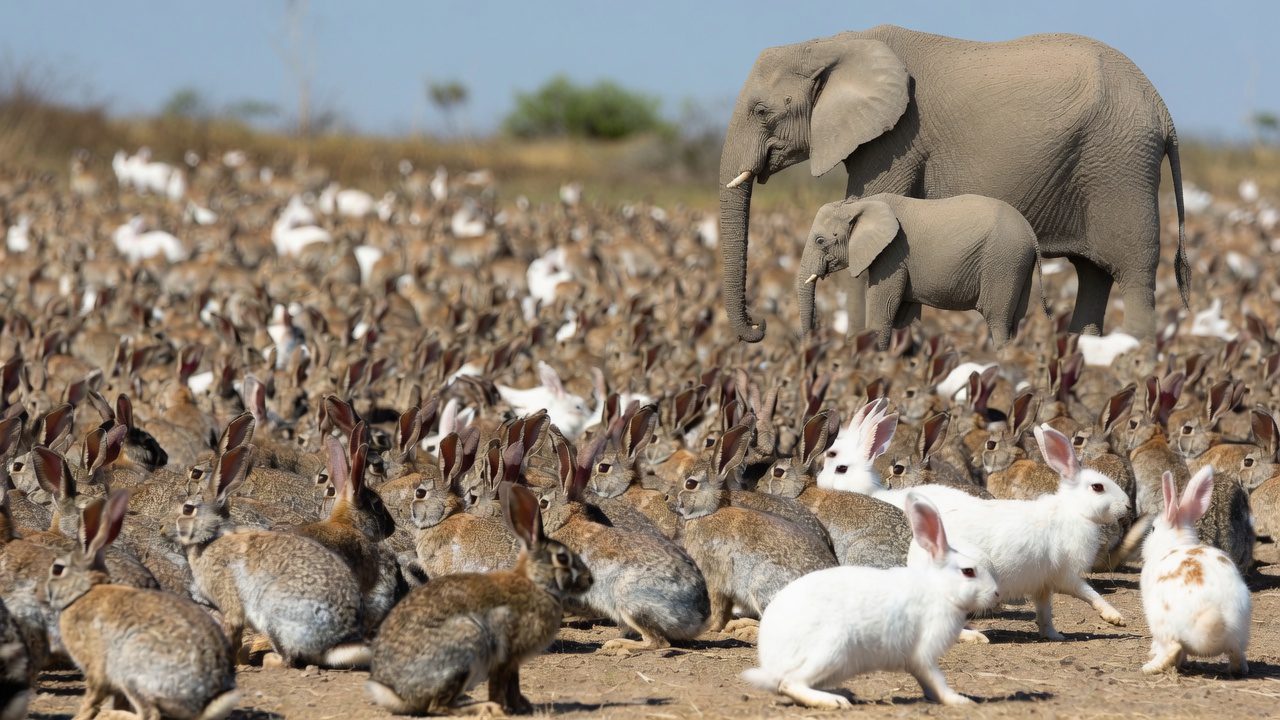
- Starts breeding at 10–11 years old
- Gémmiñ gu yàgg ñaar-fukki weer
- 4–9 years between calves
- Gémel yi ñàkk nañu lool.
One leader, one disciple at a time — only ever as deep as one person can personally reach. Slow, complicated, dependent on the one. This is addition.
- Bu amee juróom-benn weer, day tàmbalee jur.
- 30 fanu ëmb
- 4–12 babies per litter
Benn jigéen ak doomam, ci xalaat, mën nañoo jur 50,653 ci ñetti at, Juróom-benn fukki milyoŋ ak juróom-ñeent ci juróomi at, ak Juróom-benn fukki milyaar ak ñeent ci juróom-ñaari at.
Every disciple becomes a disciple-maker, who makes another, who makes another — simple and reproducible enough that anyone can pass it on. This is multiplication.
Lu tax gaawaay bi am solo ngir 2033
2033 marks roughly 2,000 years since Jesus gave the Great Commission. That can feel impossibly far from “reaching the whole world” — until you remember that multiplication, not addition, is how small things become large fast.
Picture one disciple-maker who disciples two people a year who become disciple-makers themselves — and the pattern repeats:
Atum juróomeel: 32 • Atum fukkeel: 1,024 • Atum ñaar-fukkeel over 1 million • Atum fanweeri over 1 billion • Atum fanweer ak ñatt: Lu ëpp askanu àddina si.
That is not a prediction of exactly how or when — only God knows the day or the hour. It is a picture of what is mathematically possible when multiplication replaces addition. It is why a process only a gifted leader can reproduce quietly caps a movement at one generation, while a pace ordinary people can copy keeps the chain unbroken for 10, 20, 30 generations — Kër ba kër. Dëkk ba dëkk. Réew ba réew. Kontinã ba kontinã. Ba àddina sépp xam.